Moving beyond binary—how the fusion of qubits and neural networks is solving the unsolvable.
For decades, Moore’s Law provided a reliable roadmap for progress. But as transistors approach the size of a single atom, classical physics has hit a wall. In 2026, the “Compute Crunch” is real: Large Language Models and complex multimodal systems are demanding more energy and time than traditional data centers can sustainably provide.
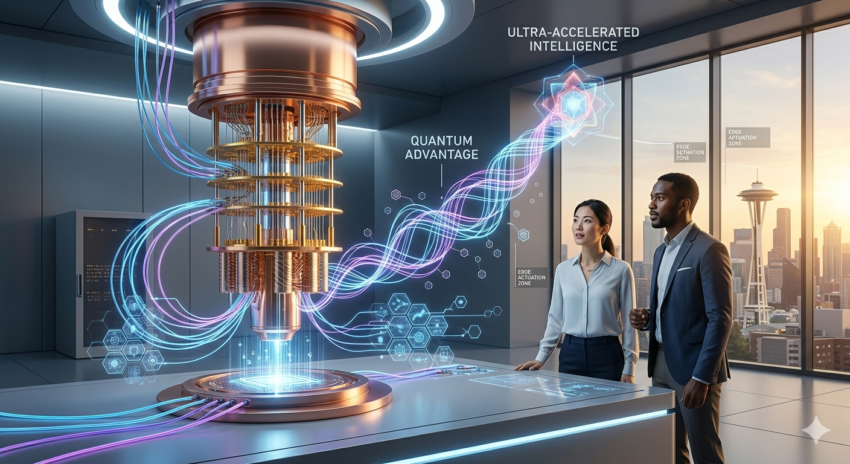
Enter Quantum AI. By leveraging the principles of superposition and entanglement, quantum computers aren’t just “faster” versions of classical computers; they process information in an entirely different dimension.
The Qubit Advantage: Parallelism Redefined
In a classical computer, a bit is either a 0 or a 1. In the quantum realm, a qubit exists in a superposition of both states simultaneously. When applied to machine learning, this allows for a level of parallel processing that is mathematically impossible for even the most advanced GPU clusters.
Qubits vector illustration. Infographic with superposition and entanglement
While a classical system must check every possible solution to a problem one by one, a quantum system can evaluate a vast landscape of possibilities all at once. For Machine Learning Workloads, this means that optimization tasks—the process of “training” an AI to find the most accurate answer—can be completed in seconds rather than months.
Solving the “Optimization Wall”
Modern AI training is essentially a massive optimization problem: finding the lowest point in a complex mathematical landscape of billions of parameters. Classical “gradient descent” can often get stuck in local minima (false peaks).
Quantum algorithms, specifically Quantum Approximate Optimization Algorithms (QAOA), allow the system to “tunnel” through these mathematical barriers. This results in:
- Hyper-Efficient Training: Reducing the carbon footprint of AI by completing training cycles with a fraction of the energy.
- Complex Molecular Modeling: Allowing AI to simulate new drugs or materials at the atomic level, a task that would take a classical supercomputer a thousand years.
- Real-Time Financial Engineering: Calculating global market risks and “black swan” events in milliseconds.
The Role of Cloud Computing Architecture
In 2026, you don’t need a cryogenically cooled quantum lab in your basement to access this power. The most significant development has been the integration of quantum processors into standard Cloud Computing Architecture.
The “Hybrid Quantum-Classical” model is the current enterprise standard. Classical computers handle the data input, storage, and user interface (the Digital Transformation Services layer), while specific, high-intensity mathematical “kernels” are offloaded to a quantum processing unit (QPU) in the cloud. This seamless handoff is managed by advanced Intelligent Software Ecosystems that determine which parts of a task require quantum speed and which can be handled by standard silicon.
The Security Mandate: Quantum-Resistant AI
Speed is not the only factor. The rise of Quantum AI has also forced a total rewrite of Cybersecurity & Data Protection. Because quantum computers can theoretically crack the RSA encryption that protects the world’s data, 2026 has seen a massive shift toward “Post-Quantum Cryptography.”
Enterprises are now using AI to build their own security moats. AI Ethics & Governance teams are deploying quantum-resistant algorithms to ensure that as we gain the speed of the future, we do not lose the privacy of the present.
Custom Development in the Quantum Age
For organizations looking to lead their industries, the focus has shifted toward Custom AI Development tailored for quantum hardware. You cannot simply “port” a classical Python script to a quantum machine. It requires a new era of Data Engineering Services where data is encoded into quantum states.
Leading tech hubs are now training “Quantum Architects”—professionals who understand both the high-level business Intelligence Strategy and the low-level physics required to run a quantum-enhanced neural network.
Conclusion: The Quantum Leap is Now
We are moving from an era of “Artificial Intelligence” to “Accelerated Intelligence.” Quantum AI isn’t just a hardware upgrade; it is a fundamental shift in what is possible. As computational speed ceases to be a constraint, our focus will move from “How long will this take?” to “What should we solve next?”
The next era of tech isn’t about doing things faster; it’s about doing things that were previously impossible.