
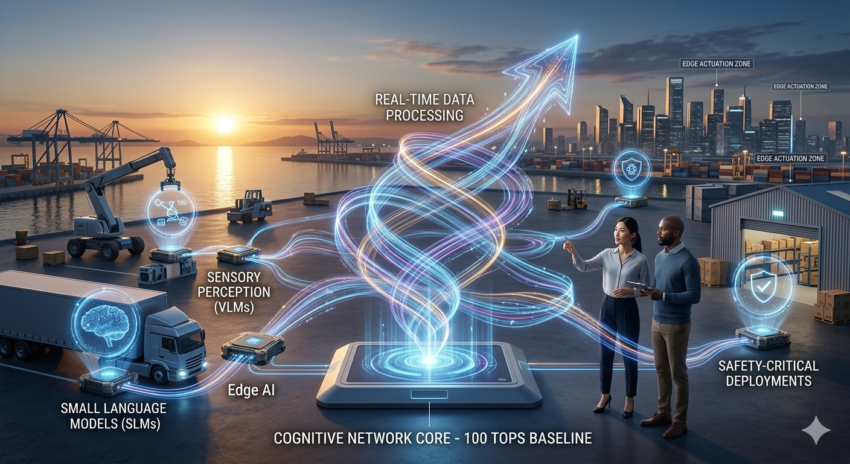
Moving from cloud-dependent inference to self-healing, autonomous cognitive ecosystems.
The term “network” has undergone a fundamental transformation. We are no longer discussing simple pipes that transport data from point A to point B. We are entering the era of Cognitive Networks—intelligent infrastructure that doesn’t just move data, but senses, reasons, and self-optimizes in real-time. This evolution is driven by the convergence of high-performance edge hardware and a new class of “Micro-intelligence” that functions with sub-10ms latency.
1. The “Power of Small”: The Rise of SLMs
The most significant development in 2026 is the transition from gargantuan, general-purpose models to Small Language Models (SLMs). While 2024 was the year of the 175-billion-parameter giant, 2026 belongs to the 1-billion to 10-billion parameter specialist.
These SLMs (such as Microsoft’s Phi-4 or Google’s Gemma 2 2B) are specifically “distilled” to run locally on hardware with limited memory. By focusing on specific tasks—industrial diagnostics, retail inventory, or medical telemetry—these models provide 95% of the reasoning power of a cloud-based LLM at a fraction of the computational cost.
- Local Inference: Decisions are made on-device, bypassing the “Latency Wall.”
- Reduced Footprint: SLMs fit into 14–26 GB of VRAM, making them compatible with modern edge servers and high-end mobile devices.
2. Hardware Milestones: The 100 TOPS Threshold
In 2026, a new “Golden Benchmark” has emerged for edge hardware: 100 TOPS (Trillion Operations Per Second). This level of compute is now the entry ticket for any organization serious about Embodied AI—AI that exists within a physical body, such as a robot or an autonomous vehicle.
At 100 TOPS, edge devices can process Multi-Modal Ultra-HD Perception simultaneously. This means a single node in a smart factory can ingest 4K video, 3D LiDAR, and acoustic sensors, merging them into one real-time intelligence stream. This allows robots to translate complex human commands into mechanical actions—a field known as Vision-Language-Action (VLA)—without needing to “ask the cloud” for instructions.
3. Cognitive Networks: The Self-Healing Grid
A Cognitive Network functions like a biological nervous system. In 2026, these networks use Edge AI to become predictive rather than reactive.
“Autonomous self-healing validation is no longer a luxury; it is a requirement for 2026 infrastructure.”
If a node in an industrial cognitive network detects a micro-fluctuation in power or a 0.01% drift in sensor accuracy, the network doesn’t wait for a human admin. It uses Zero-Touch Autonomy to:
- Identify: Recognize the degradation through local anomaly detection.
- Remediate: Reroute traffic or restart sub-processes locally.
- Verify: Confirm the “healing” was successful through a closed-loop feedback system.
This ensures that Safety-Critical Deployments, such as smart grids or surgical robotics, remain uninterrupted even during local hardware failures.
4. Privacy by Design: The Regulatory Shift
2026 has brought a wave of new statutes, including the EU Data Act and various U.S. state AI laws (Texas, California). These regulations mandate AI Transparency and strict data residency rules.
Edge AI is the primary tool for compliance. By processing data at the source, organizations achieve Privacy by Design. Sensitive data—such as patient health records or proprietary manufacturing secrets—never leaves the local facility. Only the “insights” (the processed, anonymized results) are sent to the central cloud for long-term storage. This minimizes the “Privacy Leak” inherent in traditional cloud-first architectures.
5. The Hybrid AI Infrastructure Strategy
The most successful enterprises in 2026 are not abandoning the cloud; they are mastering the Hybrid AI Infrastructure. This is the art of balancing intelligence across three distinct tiers:
| Tier | Function | Goal |
| Cloud Tier | Massive training, historical analytics, and fleet-wide learning. | Long-term strategy. |
| Gateway/Regional Edge | Aggregating data from multiple devices, heavy local analytics. | Coordination. |
| Extreme Edge (On-Device) | Real-time inference, sub-10ms response, safety logic. | Immediate action. |
This “Split-Brain” architecture ensures that while the central AI learns from every encounter across the globe, the local AI acts with the speed and situational awareness required for the immediate physical world.
6. Challenges: The Scale and Maintenance Gap
While the benefits are immense, 2026 has revealed the “Maintenance Gap.” Managing a fleet of 50,000 Edge AI nodes is vastly different from managing one cloud cluster. Organizations are now investing heavily in On-Orbit Servicing (OOS) concepts for space-based nodes and specialized robotic technicians for terrestrial ones.
The complexity of hardware diversity—handling different NPUs, GPUs, and TPUs across a global fleet—requires sophisticated Intelligent Software Ecosystems that can abstract the hardware layer, allowing developers to write code once and deploy it to any edge device.
Conclusion: The Intelligence of Everywhere
We are moving from an era of “Artificial Intelligence” to “Distributed Intelligence.” In 2026, the smartest companies aren’t those with the biggest data centers, but those with the most responsive, cognitive, and resilient edge networks.
By pushing reasoning power to the very edge of the network, we are creating a world where every device is a reasoning partner, every network is self-healing, and every action is taken in real-time. The era of the cloud as a central “brain” is ending; the era of the cloud as an “orchestrator” for billions of edge brains has begun.