Navigating the 2026 Compute Crunch with Sovereign Intelligence Networks.
Introduction: The Death of the “Cloud Crutch”
In the fast-moving tech landscape of April 2026, we’ve officially hit what engineers are calling the “Latency Wall.” For the last few years, the industry’s “Cloud-First” obsession worked fine for basic chatbots. But as we move into the era of Embodied AI—where intelligence lives in drones, humanoid robots, and autonomous vehicles—the old way of sending data to the cloud is effectively dead.
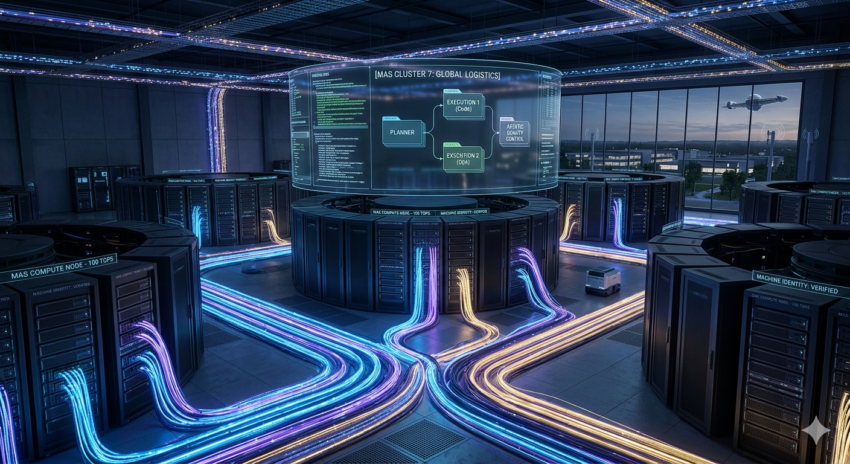
The problem isn’t just speed; it’s the 2026 Compute Crunch. Global energy grids are struggling to keep up with massive centralized server farms. If your business depends on a “remote control” AI that lives 2,000 miles away, you aren’t just slow—you’re a liability. This is why the industry has pivoted to a new gold standard: 100 TOPS NPU Hardware.
1. Decoding 100 TOPS: The New Speed Limit
First, let’s talk numbers. TOPS stands for Trillion Operations Per Second. In 2024, having 10 TOPS was a neat trick. In 2026, it’s the bare minimum for entry. Whether you’re using Dell PowerEdge XR8000 series servers at the edge or NVIDIA Jetson Orin modules in a robot, you need triple-digit performance to handle Real-Time Spatial Reasoning Engines.
To make a machine move through a crowded warehouse, the processor has to juggle a “data firehose” of 4K video feeds and LiDAR point clouds. A 100 TOPS NPU provides the “human-grade brain” necessary to digest this information locally. This is the foundation of Cognitive Edge Computing—where the device doesn’t just record the world; it understands it.
2. Software That Powers the Edge: GitHub, Cursor, and Vercel
Building for 100 TOPS hardware requires a new breed of developer tools. We are seeing massive traffic spikes for AI-native IDEs like Cursor AI and GitHub Copilot (Agent Mode).
- Cursor AI: With its “Composer” mode, developers are now managing entire codebases at once, specifically optimizing for Small Language Model (SLM) Deployment.
- GitHub Copilot: Now integrated into every major workflow, it allows for AI-Native DevOps Automation, where the AI suggests the most efficient way to utilize local NPU cycles.
- Vercel v0: For the frontend, Vercel is dominating the market by allowing developers to generate and deploy AI-Native Infrastructure layouts in seconds, ensuring that the user interface is as fast as the edge processor.
3. The Multiagent Shift: MAS Orchestration
We are no longer just deploying one AI; we are deploying Enterprise Multiagent Systems (MAS). Platforms like TrueFoundry and LangChain Hub are seeing millions of downloads as companies build “digital workforces.”
- The Orchestrator: Tools like CrewAI and AutoGen allow different agents to talk to each other. One agent monitors the 100 TOPS sensor feed, while another agent on a Dell NativeEdge platform handles the logic of what to do next.
- The Execution: By using Agentic AI Orchestration, companies can automate 90% of their warehouse logic without a single human in the loop.
4. Privacy via Edge AI Sovereignty
In 2026, sending your private office video to the cloud is a massive liability. This is where Sovereign Intelligence Networks come in. By using tools like Akamai EdgeWorkers or Spectro Cloud Palette, businesses can run their AI logic globally but keep the raw data local. This is Privacy by Design. The 100 TOPS NPU looks at the video, pulls out the “insight” (e.g., “The warehouse door is open”), and then deletes the footage. Your proprietary data never hits the open web, making it the ultimate shield against data leaks and providing Self-Healing Cyber Governance.
5. Infrastructure as Code: Terraform and Ansible
You can’t manage millions of edge devices manually. High-traffic tools like HashiCorp Terraform and Red Hat Ansible have evolved into Autonomous Infrastructure as Code platforms.
- Terraform: Used to define the Hybrid-Orbit Cloud Infrastructure that connects your local 100 TOPS nodes to space-based backups.
- Ansible: Automates the Machine Identity verification for every device on your network, ensuring that only authorized NPUs can access your core data.
6. The Real-World Impact: Real-Time Spatial Reasoning
Let’s look at a real-world scenario: An autonomous drone using Real-Time Spatial Reasoning Engines. Without a 100 TOPS brain, that drone has to take a picture, send it to the cloud, and wait for an answer. With the 2026 Compute Crunch causing cloud delays, that drone is going to crash. With Cognitive Edge Computing, the drone processes the bird’s flight path locally. It uses its NPU to predict where the bird will be in 100 milliseconds and adjusts. This is the difference between a successful delivery and a headline-making accident.
7. Cybersecurity: Post-Quantum Machine Identity
As we deploy millions of these “brains,” security has moved to Post-Quantum Machine Identity. Standard passwords are dead. Devices now use cryptographically secure IDs verified through platforms like Snyk and Lacework. This ensures that when a Long-Running Execution Agent makes a change to your edge network, you know exactly which “brain” did it.
8. The Future: Hybrid-Orbit and 100 TOPS
The ultimate goal for 2026 is a Hybrid-Orbit Infrastructure. Your local 100 TOPS NPU handles the “now,” while orbital data centers handle the global “learning.” Companies like Dell, NVIDIA, and AWS are racing to provide the hardware and software that bridges this gap. If you aren’t building for the edge, you aren’t building for the future.