From writing code to managing intelligence—how the SDLC is being reconfigured in 2026.
In 2026, the era of the “Coding Assistant” has ended. It has been replaced by the era of the Autonomous Coding Agent. We have moved beyond the “chat and paste” workflows of the early 2020s. Today, software development is characterized by Agentic AI—systems that don’t just suggest the next line of code, but reason, plan, and execute multi-day engineering tasks with minimal human intervention.
The Shift to Long-Running Execution
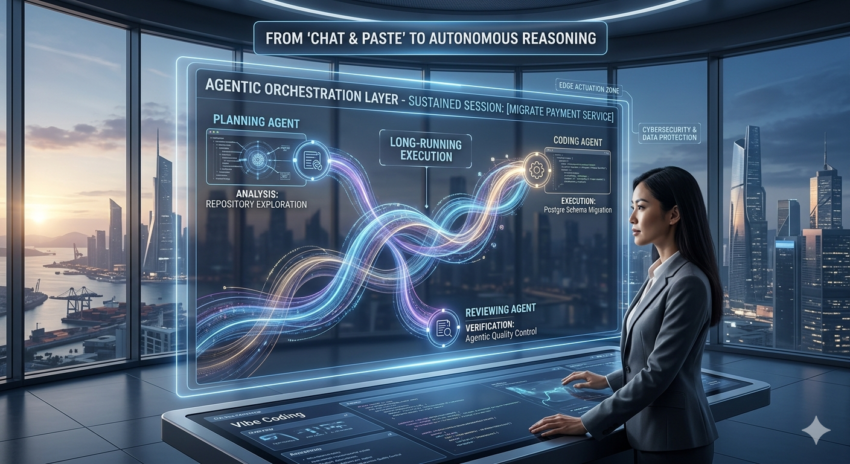
The most profound change this year is the move toward Long-Running Execution. Traditional tools were limited to short, stateless interactions. Modern agents like Claude Code, RooCode, and Cursor Automations now operate across “sustained sessions.” They can spend hours exploring a legacy repository, identifying architectural bottlenecks, and implementing complex refactors across dozens of files simultaneously.
Instead of a developer asking, “How do I fix this bug?”, the 2026 workflow begins with a higher-level command: “Migrate the entire payment service to the new PostgreSQL schema and ensure all unit tests pass.” The agent then enters a loop of:
- Analysis: Exploring the repository to understand dependencies.
- Planning: Decomposing the task into a multi-stage specification.
- Execution: Modifying code and running shell commands.
- Verification: Debugging its own failures until the definition of done is met.
Engineers as Strategic Orchestrators
This transition hasn’t replaced the software engineer; it has elevated them into the role of a Strategic Orchestrator. The “full-stack” developer of 2026 is no longer defined by their knowledge of syntax, but by their ability to manage a team of specialized AI agents.
According to the 2026 Agentic Coding Trends Report, engineers are now focusing on:
- System Architecture Design: Defining the “blueprints” that agents must follow.
- Agent Coordination: Managing the handoffs between planning agents, coding agents, and reviewing agents.
- Quality Evaluation: Acting as the final “gatekeeper” for security and architectural integrity.
The Rise of “Vibe Coding” and Rapid Prototyping
A term that emerged in late 2025 and matured in 2026 is “Vibe Coding.” This describes a workflow where developers iterate on high-level designs and “vibes” (general directions) while the AI handles the implementation details. This has led to a collapse in prototyping timelines; what used to take weeks to build as a Minimum Viable Product (MVP) now takes hours.
Security and AI-Driven Governance
With the explosion of AI-generated code, Cybersecurity & Data Protection have become automated. 2026 tools now include Agentic Quality Control as a standard feature. These background agents continuously scan for vulnerabilities, ensure compliance with AI Ethics & Governance standards, and enforce technical debt limits before a single line of code reaches the CI/CD pipeline.
Conclusion: The Collaborative Discipline
Coding in 2026 is a collaborative, intelligent discipline. We have moved from “Human + Tool” to “Human + Team of Agents.” By delegating the repetitive, implementation-heavy tasks to autonomous systems, human engineers are finally free to solve the higher-order problems that require true creativity and empathy.