From static provisioning to self-healing, autonomous cloud orchestration in the era of Agentic AI.
The “Infrastructure as Code” (IaC) we knew in 2024 was declarative and deterministic. You wrote a manifest, and a tool executed it. But in 2026, we have crossed into the realm of AI-Native Infrastructure as Code. This shift represents a transition from “static scripts” to “living systems”—infrastructure that is not just defined by code, but managed and evolved by Agentic AI systems capable of real-time reasoning and autonomous remediation.
1. The Death of the Static Manifest
For years, the industry struggled with the “Provisioning Lag”—the gap between a developer’s intent and the infrastructure’s readiness. Traditional IaC required humans to predict every variable: scaling limits, security groups, and networking routes.
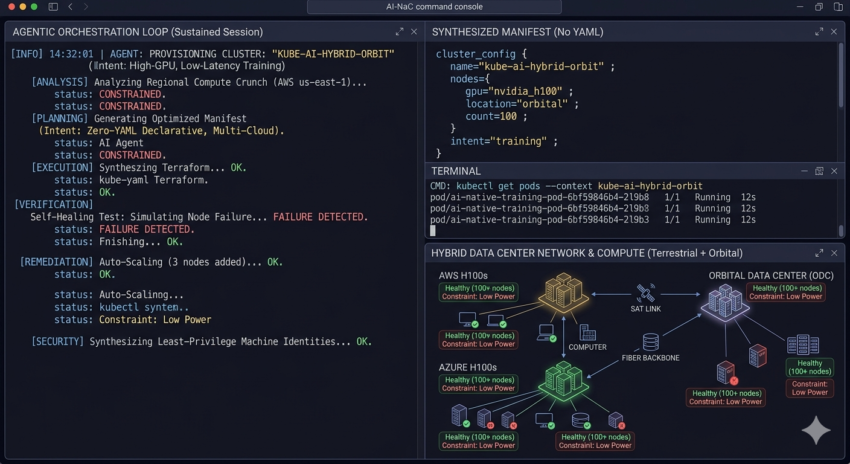
In 2026, AI-Native Infrastructure has replaced the static manifest with “Intent-Based Orchestration.” Instead of defining how to build a cluster, engineers now define the outcome. An autonomous agent takes that intent, analyzes current cloud provider availability, evaluates the Compute Crunch (the ongoing global shortage of GPU resources), and synthesizes the optimal environment in seconds.
2. Agentic AI: The New Cloud Architect
The most significant emerging keyword of 2026 is Agentic AI. Unlike the “Copilots” of the past that merely suggested code, these agents are “Digital Employees” capable of Long-Running Execution.
When an agentic system is tasked with deploying a new service, it doesn’t just run a terraform apply. It performs a multi-step loop:
- Contextual Discovery: It scans the existing global footprint to avoid resource duplication.
- Predictive Scaling: It analyzes historical traffic patterns to provision just enough compute to avoid waste while maintaining p99 latency targets.
- Security Synthesis: It automatically generates least-privilege Machine Identities for every microservice, ensuring that security is a native part of the infrastructure, not an afterthought.
According to the Gartner 2026 Infrastructure Roadmap, by the end of this year, over 60% of enterprise cloud deployments will be initiated and managed by autonomous agents rather than manual human pipelines.
3. The Self-Healing Grid: Drift is Dead
One of the greatest pains of traditional DevOps was “Infrastructure Drift”—the slow divergence between the code in Git and the actual state of the cloud. In 2026, Self-Healing Infrastructure has made drift a thing of the past.
AI-native systems operate on a “Continuous Reconciliation” model. Autonomous agents act as 24/7 SREs (Site Reliability Engineers). If a security group is manually altered or a pod fails in a way that isn’t covered by a standard health check, the agent uses Agentic Quality Control to detect the anomaly, reason through the fix, and restore the desired state—often before a human is even notified.
[Infographic: The Loop of Continuous Reconciliation in AI-Native IaC]
4. Navigating the “Compute Crunch”
As generative AI demand continues to skyrocket in 2026, we are facing a persistent Compute Crunch. GPU lead times and energy constraints have made cloud resources a volatile commodity.
AI-Native Infrastructure provides the only viable solution to this scarcity. These systems utilize “Dynamic Resource Arbitrage,” where agents automatically move non-latency-sensitive workloads between different regions or even different cloud providers (AWS, Azure, and Google Cloud) based on real-time spot pricing and energy availability. This is the cornerstone of a true Hybrid AI Infrastructure, where intelligence is used to manage the very hardware it runs on.
5. Cybersecurity & Data Protection as Code
In the autonomous era, human-scale security is too slow. 2026 has seen the rise of AI-Driven Governance. Every piece of infrastructure generated by an agent is subjected to an automated “Threat Model Simulation” before it goes live.
- Machine Identity for Agents: Agents now have their own verifiable identities, ensuring that every infrastructure change is traceable and authorized.
- Predictive Security: Rather than waiting for a breach, the infrastructure uses AI to deploy “honeypots” and “deception layers” dynamically, moving the core assets away from detected scanning patterns.
6. The Human Role: From “Builder” to “Supervisor”
If the AI is writing the code, provisioning the servers, and healing the drift, what is left for the human engineer?
The role has evolved into the Agent Supervisor. In 2026, platform engineering is about setting the “Guardrails” and “Policies.” Humans define the AI Ethics & Governance frameworks—the rules of engagement that the agents must follow. The human engineer is now the “Judge” of the infrastructure, while the AI is the “Architect” and “Worker.”
Conclusion: The Infrastructure of Tomorrow
We are moving away from a world where we “manage” computers toward a world where we “direct” intelligence. AI-Native Infrastructure as Code is the final piece of the puzzle that allows AI to truly scale. By removing the friction of manual configuration and replacing it with the speed of autonomous reasoning, we are building a foundation for a digital world that can grow as fast as our ideas.
The sky is no longer the limit—the limits are now defined only by the guardrails we set for our autonomous partners.