
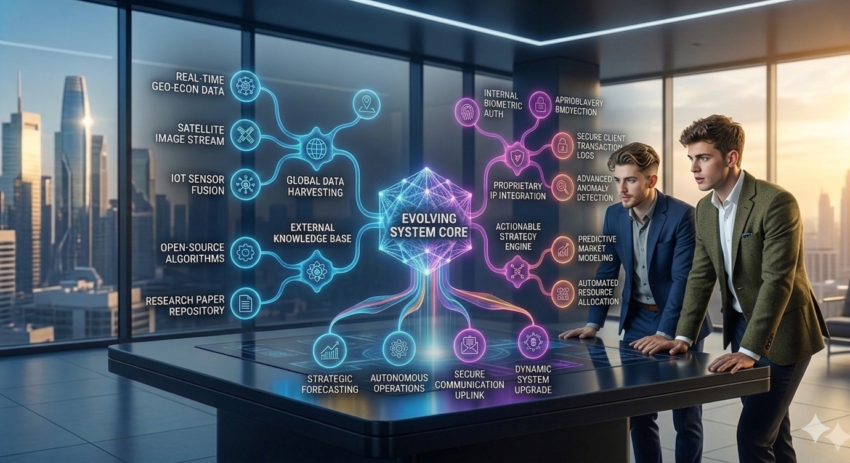
Why the most successful AI strategies are no longer binary, but modular.
In the early 2020s, the “Build vs. Buy” decision was simple: if you had a massive engineering team, you built your own models; if you didn’t, you bought an API subscription. By 2026, that simplicity has vanished. The rise of Agentic AI and Custom AI Development has created a reality where “buying” often requires a significant “build” component to make the tool useful, and “building” almost always relies on foundational “bought” components.
The modern consensus among CTOs and strategy leaders is that the competitive edge no longer lies in the model itself, but in the Intelligence Strategy used to orchestrate it.
The Death of the “Pure Buy” Strategy
For years, the promise of “Out-of-the-Box AI” was the dream of the enterprise. However, as noted in the 2026 Stanford HAI AI Index, generic models have hit a “performance ceiling.” A model that knows everything about the world but nothing about your specific supply chain, customer legacy data, or internal compliance nuances is a liability, not an asset.
When you “Buy” a generic AI solution in 2026, you face three primary risks:
- Data Homogenization: If you use the same model as your competitors, you have the same insights as your competitors. There is no alpha.
- The Black Box Problem: In high-stakes industries like healthcare or finance, a “bought” model that cannot explain its reasoning (lack of transparency) fails Regulatory Compliance Software standards.
- Vendor Lock-In: Relying on a single provider for your “brain” makes your entire Digital Transformation Services stack vulnerable to price hikes or service changes.
The Rise of the “Hybrid Model”
The shift toward Hybrid AI Models allows modern organizations to maintain ‘change fitness’—the agility to swap out foundational cloud components while keeping proprietary logic in-house.
1. Buying the Foundation (The Infrastructure)
Almost no one “builds” a trillion-parameter model from scratch anymore. The cost—both in capital and carbon footprint—is too high. Instead, enterprises “buy” access to specialized foundational models via Cloud Computing Architecture. These models serve as the “raw processing power” of the system.
2. Building the Context (The RAG Layer)
This is where the “Build” starts. Companies are building proprietary Retrieval-Augmented Generation (RAG) pipelines. By building this layer, you ensure that the “bought” model only speaks using your private, encrypted, and verified data. This effectively creates a private version of a public intelligence.
3. Orchestrating the Agents (The Logic Layer)
In 2026, we don’t just talk to AI; we deploy AI agents. Building the Autonomous Automation Systems that manage these agents is the new “Build” frontier. This involves coding the “logic” that tells the AI when to access a database, when to send an email, and when to ask a human for permission.
Economic Impact: The Shift in Machine Learning Workloads
The shift to ai hybrid models has fundamentally changed how companies allocate their budgets. In 2025, spending was heavily weighted toward API tokens. In 2026, the budget has shifted toward Data Engineering Services and Intelligent Software Ecosystems.
Organizations have realized that the “Build” portion of the hybrid model is where the ROI actually lives. According to a 2026 MIT Technology Review report, companies using a hybrid model saw a 32% faster time-to-market compared to those building from scratch, and a 22% higher accuracy rate than those using pure “off-the-shelf” solutions.
The Security and Ethics Factor
One of the strongest arguments for the “Build” component of the hybrid model is Cybersecurity & Data Protection. When you build your own middleware and orchestration layers, you can implement:
- On-Premise Inference: Keeping sensitive data within your own firewalls.
- Audit Trails: Building custom logging that tracks exactly why an AI made a specific decision, which is critical for AI Ethics & Governance.
- Differential Privacy: Building layers that scrub PII (Personally Identifiable Information) before it ever touches the “bought” foundation model.
Key Performance Indicators (KPIs) for the Hybrid Model
When evaluating whether to build or buy a specific component of your AI stack in 2026, consider these four metrics:
| Metric | Buy the Component If… | Build the Component If… |
| Commodity vs. Core | The task is standard (e.g., transcription). | The task is your “Secret Sauce” (e.g., pricing logic). |
| Speed to Market | You need a solution in days/weeks. | You are playing a 5-year strategic game. |
| Data Sensitivity | The data is public or low-risk. | The data is proprietary or highly regulated. |
| Total Cost of Ownership | You have low volume and want to pay-per-use. | You have high volume and want to reduce marginal costs. |
The Future: Agentic Orchestration
As we look toward 2027, the “Build vs. Buy” debate will evolve into “Orchestrate vs. Delegate.” The winners will be the firms that “buy” the best raw intelligence and “build” the most effective Enterprise Intelligence & Strategy to manage it.
The hybrid model is not just a technical choice; it is a statement of intent. It says that your company is not just a consumer of AI, but an architect of it. By leveraging Custom AI Development within a framework of bought power, you create a system that is faster, safer, and—most importantly—uniquely yours.
Conclusion: Finding Your Ratio
There is no “perfect” ratio of Build to Buy. A startup might be 10% Build and 90% Buy to stay lean, while a Fortune 500 bank might be 70% Build and 30% Buy to ensure absolute security.
The 2026 mandate is clear: Buy for speed, build for differentiation, and integrate for survival. In the world of Digital Evolution, the “Middle Path” is the only one that leads to a sustainable competitive advantage.