
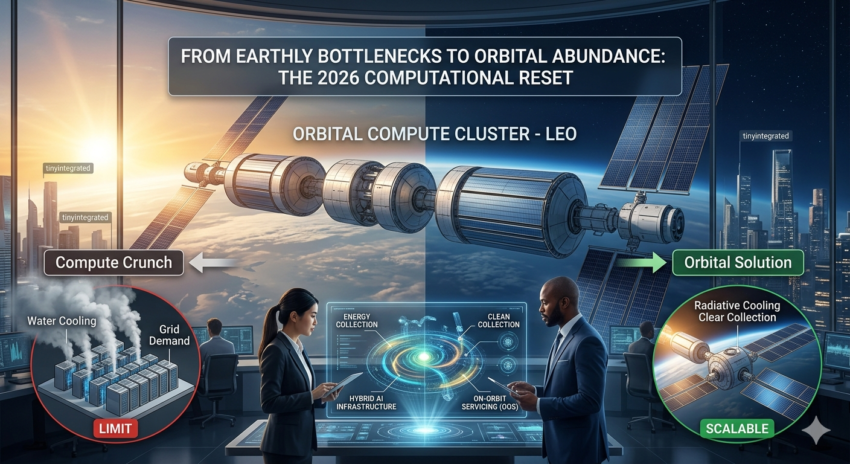
Why the sky is no longer the limit—it is the solution to Earth’s energy and environmental bottlenecks.
The traditional terrestrial data center model is under siege. Modern gigawatt-scale clusters can consume more fresh water annually than a city of 50,000 for cooling, while the electricity required to power them is driving consumer energy bills to record highs. In 2026, constructing a new facility on Earth can take a decade due to complex regulatory hurdles and grid interconnection delays.
Space-based infrastructure bypasses these “Earthly headaches” by placing processing power in Low Earth Orbit (LEO). This realm is characterized by abundant energy, zero water consumption, and total physical isolation from the terrestrial constraints of zoning and fossil-fuel reliance.
1. The Power of the Sun: Uninterrupted Energy
On Earth, solar power is a variable resource, hampered by the day-night cycle, weather patterns, and atmospheric interference. In space, specifically within sun-synchronous “dawn-dusk” orbits, a data center can achieve near-constant illumination.
The efficiency gains are staggering. Solar arrays in space generate up to five times more energy than the same arrays on the surface because they are not hindered by atmospheric attenuation. This allows for an equivalent energy cost as low as $0.005 per kWh—nearly 15 times cheaper than current wholesale electricity prices in many tech hubs. For the massive energy requirements of AI training, this economic shift is the difference between a project being feasible or prohibitively expensive.
2. Passive Radiative Cooling: The Ultimate Heatsink
A common misconception is that “space is cold,” so cooling should be easy. While the ambient temperature is near absolute zero, a vacuum does not conduct heat. Instead, orbital data centers utilize passive radiative cooling.
While terrestrial facilities must use energy-hungry chillers and millions of gallons of water, orbital nodes utilize large-scale radiator surfaces to emit waste heat directly into the vacuum as infrared radiation.
- Zero Water Use: No fresh water is consumed, protecting one of Earth’s most vital resources.
- Liquid Metal Interface: Advanced 2026 systems use liquid metal and graphene thermal pads to transfer heat from high-density chips (like the NVIDIA H100 already tested in space) to these external radiators.
3. The 2026 Commercial Landscape: The Trillion-Dollar Race
The current year marks a historic shift from prototypes to mega-constellations. In early 2026, SpaceX filed a monumental application with the FCC for up to one million orbital data center satellites. This filing follows the massive merger of SpaceX and xAI, creating a $1.25 trillion entity dedicated to building the world’s first orbital AI supercomputer.
Other key players in 2026 include:
- Starcloud: This Y Combinator-backed startup became the first to train a Large Language Model (NanoGPT) entirely in space in late 2025. They have since filed for an 88,000-satellite constellation.
- Google (Project Suncatcher): A feasibility study by Google confirmed that if launch costs drop below $200/kg—a target Starship is poised to hit—orbital compute becomes cheaper than building on Earth.
- Kepler Communications: Already operating multiple GPU-equipped satellites in a high-bandwidth mesh network.
4. Navigating the Engineering Frontiers: Radiation and Debris
The transition to space is not without its hurdles. In 2026, three primary technical challenges define the industry’s R&D:
- Radiation Hardening: Cosmic radiation can cause “bit flips” and hardware degradation. 2026 systems utilize a mix of physical shielding and software-based fault tolerance.
- On-Orbit Servicing (OOS): Because you can’t simply send a technician to a satellite, the 2026 model relies on robotic logistics to swap modular compute blades as they age.
- Orbital Debris Mitigation: With over a million planned satellites, responsible LEO usage is critical. Systems are now designed for “Circular Sustainability,” meaning they automatically demise (burn up safely) in the atmosphere at the end of their 10–15 year life cycle.
5. The Rise of the Hybrid AI Infrastructure
It is a common misconception that the future of compute is “all or nothing.” In reality, we are moving toward a Hybrid AI Infrastructure.
- Terrestrial Centers: Preferred for latency-sensitive applications like real-time gaming or interactive voice AI where every millisecond counts.
- Space-Based Data Centers: The new heavy-lifters for high-energy tasks. This includes massive foundation model training, complex molecular simulations for drug discovery, and large-scale climate modeling.
By offloading these power-intensive workloads to orbit, companies ensure that their AI progress is no longer tethered to the constraints of the local power grid.
Conclusion: A Celestial Standard
The era of viewing data centers as merely “buildings on the ground” is ending. As the Compute Crunch intensifies, the leap into orbit provides a path to truly sustainable, scalable, and resilient intelligence. Space-based compute represents more than just a hardware upgrade; it is an ecological and economic reset.
By leveraging the unique physics of the orbital environment, we aren’t just building faster AI—we are building a future where intelligence can grow without costing the Earth.